Viva Cuba
Viva Cuba is about two best friends who are in danger of being separated forever run away from home. The friendship between two children is threatened by their parents' differences. Malu is from an upper-class family and her single mother does not want her to play with Jorgito, as she thinks his background coarse and commonplace. Jorgito's mother, a poor socialist proud of her family's social standing, places similar restrictions on her son. What neither woman recognizes is the immense strength of the bond between Malu and Jorgito. When the children learn that Malu's mother is planning to leave Cuba, they decide to travel to the other side of the island to find Malu's father and persuade him against signing the forms that would allow it.
This was the official site created to promote Viva Cuba. Content is taken from the site's archived pages.
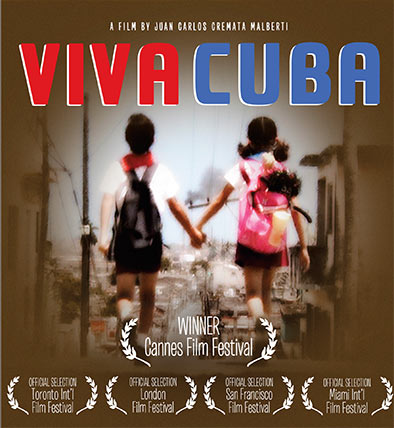
Viva Cuba was shown at the Toronto Film Festival - Sept 8 to 18, 2005
Programme: CONTEMPORARY WORLD CINEMA
Director: Juan Carlos Cremata Malberti
Country: France/Cuba
Year: 2005
Language: Spanish
Time: 80 minutes
Film Types: Colour/35mm
Rating: PG
My kids loved this film when they saw it on DVD. On my wife's side they had grandparents who had escaped from Cuba. The kids loved listening to the stories their abuela and abuelo would tell them whenever we visited them in Florida. Several years ago we returned from a school break visit to Florida to a disaster in our basement apartment in Brooklyn. A major nor'easter had struck the east coast while we were away, and I feared for our precious oriental rugs. The water damage was extensive enough for me to have to do a search for oriental carpet & rug cleaning to handle the cleanup and remediation that was obviously necessary. The company we found immediately responded to my call which my insurance appraiser later told me helped minimize the damage, as well as the cleaning and restoration costs. Three months later when our apartment was once again habitable I knew I had made the right choice. I had neighbors who were still dealing with mold issues, something that our service handled for us so that it didn't result in major problems. While I was unpacking I found the Viva Cuba DVD and decided to watch it again with the family last night. It was as enjoyable this time as the first. If you haven't seen it, you can rent it on Netflix where it has many 3 and 4 star reviews.
This was a 4 star comment: Enjoyable and entertaining movie on three levels: first, a charming tale of friendship between two high-spirited pre-teens, who are like brother sister the way they alternately fight and enjoy each other; two, a non-judgmental glimpse of the Cuban political indoctrination school kids get; and lastly, a wonderful travelogue of the Cuban cities, culture, countryside, daily life, and people in general. The story itself is a "road trip" - the two very appealing kids making their way across the entire island from Havana to lighthouse on the East end, hitching, sneaking on buses and trains, and walking. The kids are pretty good actors, the script is definitely corny at times, however, you can't help but enjoy their adventures. I had a little trouble understanding the confusing details surrounding the scam involving the jewelry bait and switch. The grandparents had been cheated out of their savings by an unscrupulous con artist who convinced them that a box full of low cost designer cubic zirconia rings were actually diamond rings. Cubic zirconia does indeed look very much like actual diamonds, but no self respecting adult would be fooled so easily into backing a guy who was obviously a criminal hawking cheap jewelry. The kids ended up treasuring a couple of cz rings that were lost under the porch when the bad guys were arrested, but grandpa made them give them back. I was rooting for the kids and disappointed by this outcome. I especially enjoyed the story ending, which is sort of subject to interpretation. The cinematography is just excellent - the colors, the camera angles, the travelogue aspects, the split screen and scene transition methods are all first rate. And I loved seeing all those old cars and buses, even the DDT truck with it's clouds of mosquito spray. A great PG type family film well worth DVD renting or Watch Instantly viewing.
Limited release in 2005
On DVD: Sep 4, 2007
Runtime: 79 minutes
+++
Credits
Production Company: Quad Productions/DDC Films LLC/TVC Casa Productora/ICRT/La Colmenita/El Ingenio
Executive Producer: Eric Brach
Producer: Nicolas Duval-Adassovsky
Screenplay: Juan Carlos Cremata Malberti, Manolito Rodríguez Ramírez
Cinematography: Alejandro Pérez Gómez
Editor: Angélica Salvador Alonso, Sylvie Landra
Production Designer: Guillermo Ramírez Malberti
Sound: Franklin Hernández Polanco, Diego Javier Figueroa Torres, Osmany Olivare Arias, Olivier Laurent, François Joseph Hors
Music: Amaury Ramírez Malberti, Slim Pezin
+++
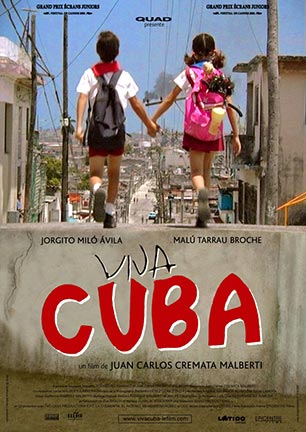
About The Film
Juan Carlos Cremata Malberti’s Nothing More was an irreverent, playful film about the burden of Cuban bureaucracy, employing light-hearted animation to treat heavy topics like migration and segregation. For his follow-up feature, Viva Cuba, Cremata Malberti again tackles localized Cuban problems, this time from the literal point of view of the country’s children. He lowers the camera to the eye level of the film’s protagonists, the darling Malú (Malú Tarrau Broche) and Jorgito (Jorgito Miló Ávila).
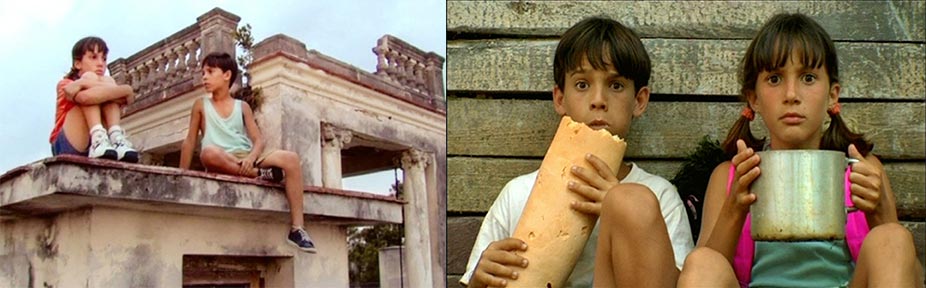
In a tale akin to “Romeo and Juliet,” the friendship between two children is threatened by their parents’ differences. Malú is from an upper-class family and her single mother (Larisa Vega Alamar) does not want her to play with Jorgito, as she thinks his background coarse and commonplace. Jorgito’s mother (Luisa María Jiménez Rodríguez), a poor socialist proud of her family’s social standing, places similar restrictions on her son. What neither woman recognizes is the immense strength of the bond between Malú and Jorgito. When the children learn that Malú’s mother is planning to leave Cuba, they decide to travel to the other side of the island to find Malú’s father and persuade him against signing the forms that would allow it.
Viva Cuba explores emigration and the effects it can have on children who have to leave friends and extended families behind. Often youngsters are uprooted without being consulted and then must contend with their new surroundings. In a poignant moment, Malú and Jorgito discuss when they might reunite. The viewer knows they are unlikely to ever see each other again, unless Malú’s mother finds a legal way to leave the country and can therefore be granted re-entry. The best they can hope for is to forget one another as their lives change and they face new pleasures and challenges.
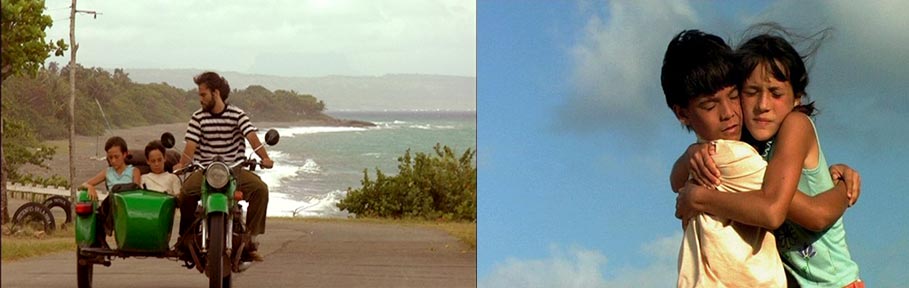
Viva Cuba is a wonderful, fresh film for all ages. It touches upon many of Cuba’s contentious issues in a frank and honest manner. This is a nation in flux and, while his approach is skilled and affectionate, Cremata Malberti does not shy away from asking difficult questions.
- Diana Sanchez
More Background on VivaCubaMovie.com
"Viva Cuba" is a 2005 Cuban-French film directed by Juan Carlos Cremata Malberti. The movie tells the story of two young friends, Malú and Jorgito, whose bond is threatened by their parents' social differences and the prospect of Malú's family leaving Cuba. This narrative explores themes of friendship, family, and social class against the backdrop of Cuban culture and society.
History and Production
"Viva Cuba" was produced by a collaboration of companies including Quad Productions, DDC Films LLC, TVC Casa Productora, ICRT, La Colmenita, and El Ingenio. The screenplay was written by Juan Carlos Cremata Malberti and Manolito Rodríguez Ramírez. The film premiered at the Toronto International Film Festival in 2005 as part of the Contemporary World Cinema program.
Reviews and Reception
"Viva Cuba" received positive reviews for its portrayal of Cuban life and culture. Critics praised the film's cinematography, which captures the vibrant colors and landscapes of Cuba, as well as its exploration of social issues through the eyes of children. The movie is often described as a charming tale of friendship and a non-judgmental glimpse into Cuban political and social realities.
Audiences appreciated the film's ability to balance light-hearted moments with deeper themes, making it suitable for a wide range of viewers. However, some viewers noted that the script could be corny at times, and certain plot elements, like a jewelry scam subplot, were confusing.
Press and Media Coverage
"Viva Cuba" garnered attention in media outlets for its unique perspective on Cuban society. The film's portrayal of social class differences and the challenges faced by children in a society undergoing change resonated with critics and audiences alike. While specific press coverage may vary, the film's participation in international film festivals like Toronto helped raise its profile globally.
Audience
The film appeals to a broad audience, including families and those interested in international cinema. It is recommended for viewers aged 10 and above due to its themes of family separation and cultural differences. The movie's PG rating and family-friendly content make it accessible to younger viewers, while its exploration of social issues engages adult audiences.
Known For
"Viva Cuba" is known for its vibrant depiction of Cuban culture and its thoughtful exploration of social issues. The film's use of child protagonists allows for a fresh perspective on complex themes like emigration, social class, and family dynamics. The cinematography is also noteworthy, showcasing the beauty of Cuba's landscapes and cities.
Cultural and Social Significance
The film offers a poignant look at the effects of emigration on children and families. By focusing on the bond between Malú and Jorgito, "Viva Cuba" highlights the human cost of social and economic changes in Cuba. The movie also celebrates Cuban culture, showcasing its music, landscapes, and daily life in a way that is both authentic and engaging.
Details and Insights
One of the film's strengths is its ability to balance entertainment with social commentary. The storyline, while simple, is powerful in its portrayal of the challenges faced by children in divided societies. The film's setting, which spans the Cuban countryside and cities, provides a visually stunning backdrop for the narrative.
The characters of Malú and Jorgito are well-developed, with their friendship serving as the emotional core of the film. Their journey across Cuba not only showcases the country's beauty but also underscores the resilience and resourcefulness of children in the face of adversity.
Examples and Specifics
A notable aspect of "Viva Cuba" is its use of real locations and everyday Cuban life to tell its story. The film features old cars, buses, and other elements of Cuban culture that add to its authenticity. The cinematography is praised for its use of color and composition, capturing the vibrant spirit of Cuba.
The film's exploration of social issues is nuanced, avoiding simplistic portrayals of complex problems. Instead, it focuses on the personal stories of its characters, making the themes more relatable and impactful.
"Viva Cuba" is a significant film that offers a unique perspective on Cuban society and culture. Its exploration of themes such as friendship, family, and social change resonates with audiences worldwide. While the film may not have a dedicated website beyond promotional materials, its impact and reception are well-documented through reviews and festival participation.
In summary, "Viva Cuba" is a charming and thought-provoking film that celebrates Cuban culture while addressing important social issues. Its appeal lies in its ability to engage both children and adults with its story of friendship and resilience.